Welcome to Your Journey of Prayer
Assalamu alaikum (Peace be upon you), dear friend! If you are a new Muslim, stepping onto the path of Islam is one of the most beautiful and courageous decisions you will ever make. Welcome to the family. Taking that first step can sometimes feel a bit overwhelming, especially when you look at the daily practices. But take a deep breath—Allah, the Most Merciful, sees your sincere efforts, your stumbles, and your heart.
One of the most important daily acts of worship you will learn is Salah (the ritual prayer). Think of Salah not as a rigid chore or a test you might fail, but as a divine appointment—a private meeting with the One who loves you more than anyone else in this world. It is your daily recharge, a moment to drop your heavy burdens, and a sanctuary of peace in a busy world.
In this guide, we are going to break down the prayer step-by-step in the easiest, most comforting way possible. Don’t worry about memorizing everything overnight. Islam is a journey, not a sprint!
Before You Begin: Purification and Preparation
Before standing before Allah in prayer, we prepare our bodies and minds. This is a two-step process involving physical cleanliness and setting the right intention.
1. Wudu (Ritual Ablution)
To pray, you need to be in a state of ritual purity. We achieve this through Wudu, a simple washing ritual of specific body parts using water. It washes away minor impurities and refreshes the body and mind:
- Start by washing your hands three times.
- Rinse your mouth three times, and gently sniff water into your nose and blow it out three times.
- Wash your face three times from ear to ear and hairline to chin.
- Wash your arms up to the elbows three times (starting with the right arm, then the left).
- Wipe your wet hands over your head and ears once.
- Wash your feet up to the ankles three times (right foot first, then left).
2. Clothing and Environment
Wear clean, modest clothing that covers your body appropriately. For men, this means at least from the navel to the knees. For women, it means covering the entire body except for the face and hands. Find a clean, quiet spot in your home and roll out a prayer rug (though any clean surface is fine).
Understanding the Units (Rak’ahs) of Prayer
Muslims pray five times a day. Each prayer is made up of units called Rak’ahs (singular: Rak’ah). A Rak’ah is a complete sequence of standing, bowing, and prostrating. The five daily prayers have a different number of Rak’ahs:
- Fajr (Dawn): 2 Rak’ahs
- Dhuhr (Midday): 4 Rak’ahs
- Asr (Afternoon): 4 Rak’ahs
- Maghrib (Sunset): 3 Rak’ahs
- Isha (Night): 4 Rak’ahs
Step-by-Step Walkthrough of a Single Rak’ah
Let’s walk through what happens inside one single unit of prayer. Once you learn one, repeating it becomes second nature!
Step 1: The Intention (Niyyah) and Takbeer
Stand facing the direction of the Kaaba in Mecca (the Qiblah). You don’t need to say your intention out loud; just know in your heart which prayer you are about to perform. Raise your hands to your shoulders or ears and say: “Allahu Akbar” (Allah is the Greatest). This phrase is called the Takbeer and it officially begins your prayer, shutting out the rest of the world.
Step 2: Standing and Reciting Al-Fatihah
Place your right hand over your left hand on your chest or upper stomach. Look down at the spot where you will place your head in prostration. If you are new, you can recite the opening chapter of the Quran, Surah Al-Fatihah, in Arabic if you’ve learned it, or read the English translation in your heart while you practice learning the Arabic sounds. Surah Al-Fatihah is the heartbeat of every prayer:
- “In the name of Allah, the Entirely Merciful, the Especially Merciful.”
- “All praise is due to Allah, Lord of the worlds.”
- “The Entirely Merciful, the Especially Merciful.”
- “Sovereign of the Day of Recompense.”
- “It is You we worship and You we ask for help.”
- “Guide us to the straight path…”
Step 3: Bowing (Ruku)
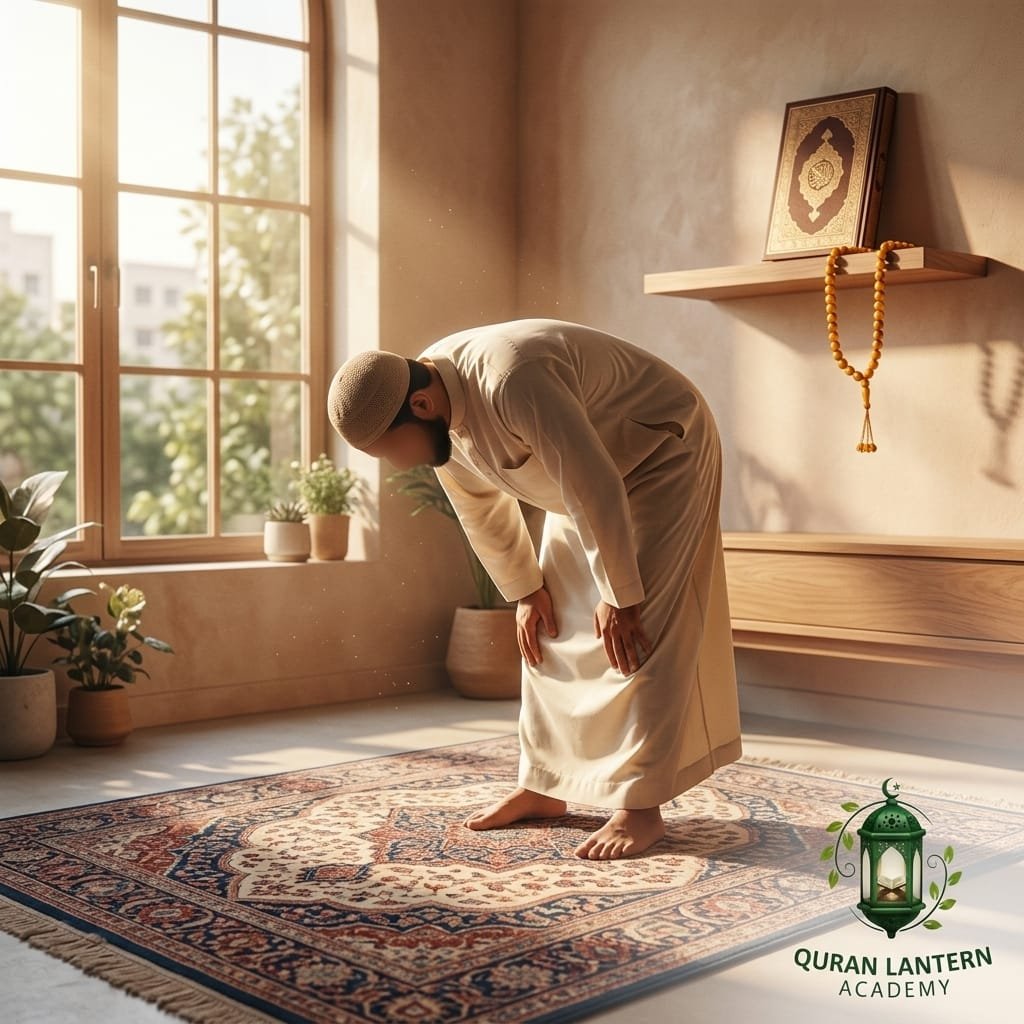
Say “Allahu Akbar” again and bow forward at the waist, placing your hands on your knees with your back straight. While bowing, gently say three times: “Subhana Rabbiyal-Atheem” (Glory be to my Lord, the Magnificent).
Step 4: Standing Back Up
Rise back up to a standing position, saying: “Sami’allahu liman hamidah” (Allah hears whoever praises Him). Once standing straight, add: “Rabbana wa lakal-hamd” (Our Lord, and to You belongs all praise).
Step 5: Prostration (Sujud) – The Closest You Are to Allah
Say “Allahu Akbar” and gently lower yourself to the floor. This is prostration (Sujud), the most beloved part of the prayer. Seven parts of your body should touch the ground: your forehead and nose, both palms, both knees, and the toes of both feet. In this humble position, you are closer to Allah than at any other time. Whisper softly three times: “Subhana Rabbiyal-A’la” (Glory be to my Lord, the Most High).
Step 6: Sitting Briefly and Second Prostration
Sit up on your knees for a brief moment, saying “Allahu Akbar”, then perform a second prostration just like the first one, repeating “Subhana Rabbiyal-A’la” three times.
Congratulations! You have just completed one full Rak’ah.
How to Apply This in Your Daily Life
Learning to pray can feel like learning a new language and a new dance all at once. Here is how you can make this transition smooth and stress-free:
- Take it One Prayer at a Time: If praying five times a day feels daunting right now, start with one or two prayers. Build the habit slowly and with love, not pressure.
- Use a Cheat Sheet: Don’t be afraid to hold a piece of paper or place your phone on a stand in front of you with the transliteration and English translations while you pray. Allah knows your intention to learn!
- Be Patient with Yourself: Mistakes happen. If you lose your count or forget a step, just make a prostration of forgetfulness at the end, or simply continue. Perfection is not expected; sincerity is.
- Make Dua (Supplication): At the very end of your prayer, before finishing, speak to Allah in your own language. Tell Him about your day, your fears, your hopes, and ask Him to make learning Islam easy for you.
Conclusion
Remember, dear brother or sister, learning to pray is a beautiful journey of connection with your Creator. You do not need to be an expert on day one. Every single stumble and every sincere effort you make is seen and deeply appreciated by the Most Merciful. At Quran Lantern Academy, we are honored to walk beside you on this incredible path. Explore our beginner-friendly courses, supportive revert community, and step-by-step resources designed to help your faith blossom. May Allah make your prayers a source of ultimate peace, joy, and closeness to Him. Ameen!