Welcome to the Heart of Your Daily Routine
As a new Muslim, taking your first steps into Islam is an incredibly exciting and beautiful journey. Among all the daily practices, the Islamic prayer, known as Salah, is often the one that brings the most peace, grounding, and direct connection to the Creator. If you are feeling a bit overwhelmed by the movements and the Arabic words, please take a deep breath. Allah sees your sincere effort, and every single stumble or mispronunciation is covered by His immense mercy and love.
At Quran Lantern Academy, we want you to know that you do not need to rush to perfection. Prayer is a gift, not a burden. This step-by-step guide is designed to gently walk you through the basics of Salah so you can begin your daily conversations with Allah with confidence and calm.
Understanding the Basics Before You Begin
Before stepping onto your prayer mat, there are a few foundational preparations to make. Don’t worry if these feel new; with practice, they will quickly become second nature.
1. Purification (Wudu)
Before praying, Muslims perform a ritual washing called Wudu (ablution). This helps us feel clean physically and spiritually. It involves washing the hands, rinsing the mouth and nose, washing the face, arms up to the elbows, wiping the head and ears, and finally washing the feet. If you are ever unsure or if your Wudu breaks, just take your time and repeat it gently.
2. Modest Clothing and a Clean Space
You will want to find a quiet, clean spot in your home and lay down a prayer rug (though any clean floor or mat will do). For men, clothing should at least cover from the navel to the knees. For women, clothing should cover the entire body except for the face and hands.
3. Facing the Direction of Prayer (Qibla)
Muslims face toward the Kaaba in Mecca, Saudi Arabia, during prayer. Don’t worry if you aren’t sure which direction that is; there are many free smartphone apps (like Qibla finders) that can help you locate it instantly in your home.
The Steps of the Prayer (Rakah)
A single unit of prayer is called a Rakah. The daily prayers consist of two, three, or four Rakahs depending on the time of day. Here is what a single Rakah looks like, broken down step by step:
- The Intention (Niyyah): You don’t need to say this out loud. Just know in your heart which prayer you are about to perform (for example, the afternoon prayer, Asr).
- Standing and the Opening Declaration (Takbir): Stand tall, raise your hands near your ears or shoulders, and say “Allahu Akbar” (God is the Greatest). This marks your entry into a sacred conversation with Allah.
- Reciting the Opening Chapter (Al-Fatiha): Place your right hand over your left hand on your chest or lower stomach. Recite the first chapter of the Quran, Surah Al-Fatiha. If you are still learning the Arabic, you can gently recite its English meaning in your heart while you practice the Arabic sounds.
- Bowing (Ruku): Bow forward from the hips, placing your hands on your knees, keeping your back straight. Quietly say “Subhana Rabbiyal Azeem” (Glory be to my Lord, the Greatest) three times.
- Standing Up Straight: Rise back up, saying “Sami’Allahu liman hamidah” (Allah hears the one who praises Him), followed by “Rabbana wa lakal hamd” (Our Lord, to You belongs all praise).
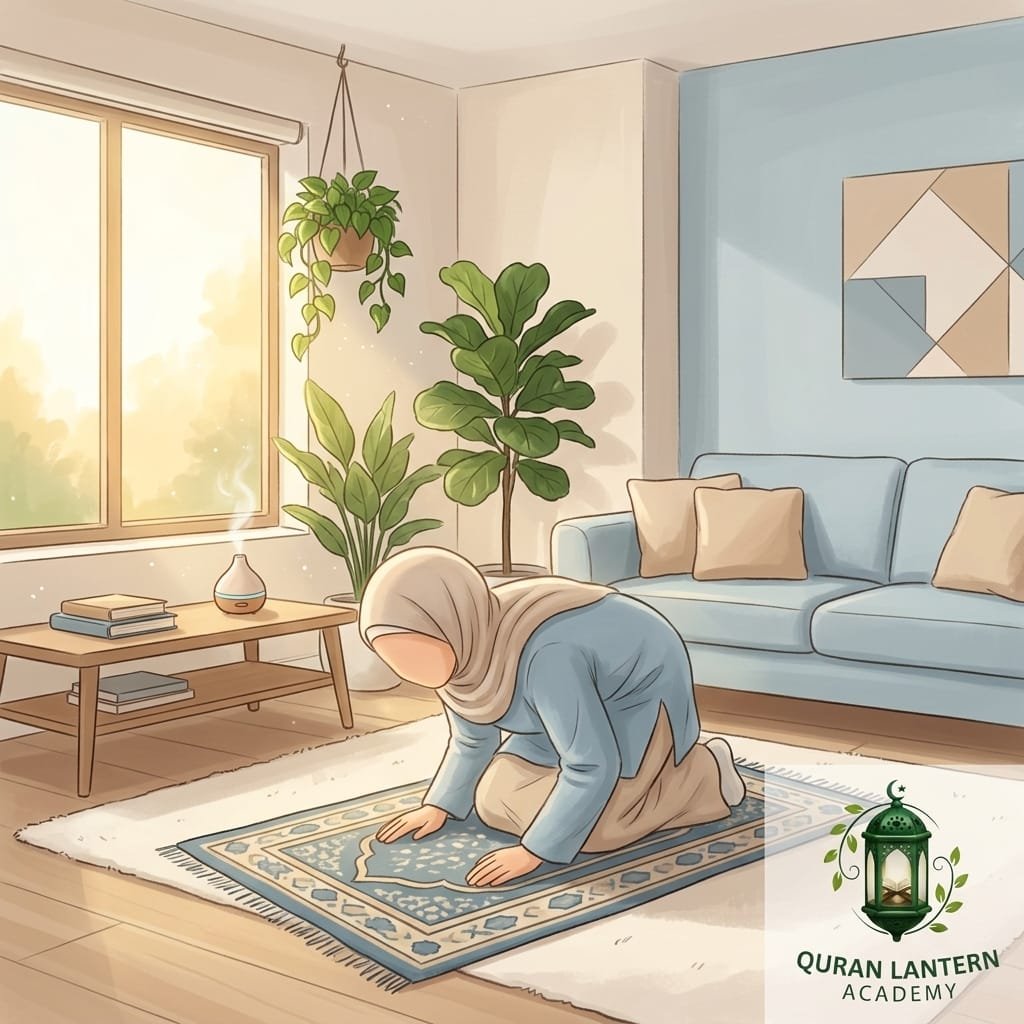
- Prostration (Sujud): This is the most beautiful part of the prayer, where you are physically closest to Allah. Gently lower yourself to the floor so that your forehead, nose, palms, knees, and toes touch the ground. In this position, whisper “Subhana Rabbiyal A’la” (Glory be to my Lord, the Most High) three times. Pour your heart out to Allah here—you can make personal supplications in your native language!
- Sitting and the Second Prostration: Sit back on your heels for a brief moment of calm, then perform a second prostration just like the first one.
Completing the Prayer
At the end of your prayer (after completing the required number of Rakahs), you will sit down completely. You will recite a series of greetings of peace and testimonies of faith (called the Tashahhud and sending blessings upon the Prophets). Finally, to exit the prayer, you turn your head to the right and say “As-salamu alaykum wa rahmatullah” (Peace and mercy of Allah be upon you), and then repeat it looking over your left shoulder.
How to Apply This in Your Daily Life
Transitioning into a life of five daily prayers can feel daunting if you try to do everything at once. Here are some compassionate, practical tips to help you apply this daily:
- Take it One Step at a Time: If praying all five prayers feels overwhelming right now, start with one or two a day. Build the habit slowly and with joy.
- Use Cheat Sheets: Keep a little notepad or a printed guide nearby with the English transliteration and translations so you can read along without stress.
- Be Gentle With Yourself: Allah does not look for flawless performances; He looks for a sincere heart trying to reach out to Him. If you forget a step or lose count, just make a small prostration of forgetfulness at the end, or simply continue.
- Make Dua (Supplication): Use your prostrations (Sujud) to talk to Allah in plain English. Tell Him about your day, your worries, and your gratitude.
Conclusion
Learning how to pray is a journey of love, patience, and consistency. Remember that every master was once a beginner, and Allah rewards you abundantly for every single moment of effort you put into learning His ways. At Quran Lantern Academy, we are honored to walk this path with you, offering resources, community, and support whenever you need it. May Allah make your prayers a source of deep comfort, light, and peace in your heart. Ameen!