Welcome to Your New Spiritual Journey
As a new Muslim stepping into the beautiful lifestyle of Islam, learning how to pray in islam is one of the most exciting and transformative milestones you will experience. Prayer, known in Arabic as Salah, is not just a daily chore or a rigid routine; it is a sacred, direct conversation with your Creator. It is your daily sanctuary, a moment of peace in a chaotic world where you can pause, breathe, and realign your heart.
If you are feeling a bit overwhelmed by the steps, postures, and Arabic words, please take a deep breath. Allah looks at your sincere effort, your patience, and your love for Him, not for perfection right away. At Quran Lantern Academy, we are walking with you every step of the way to make this learning process as smooth and comforting as possible.
Understanding the Basics of Salah
Before diving into the physical movements, it helps to understand what prayer means in the daily life of a believer. Muslims perform Salah five times a day. These prayers are spread out from dawn until late evening, anchoring your day in mindfulness and gratitude.
- Fajr: The early morning prayer, prayed before sunrise.
- Dhuhr: The midday prayer, prayed after the sun passes its peak.
- Asr: The late afternoon prayer.
- Maghrib: The sunset prayer.
- Isha: The night prayer, prayed after twilight has faded.
Each prayer takes only about 5 to 10 minutes. Think of them as five spiritual pit stops designed to recharge your soul, wash away your stress, and keep you connected to the Divine.
Preparation: Cleanliness and Purity
Before you learn how to pray in islam, you must prepare your body and environment. Cleanliness is a deeply cherished value in Islam.
1. Wudu (Ablution)
Before every prayer, you perform a ritual washing called Wudu. It involves washing your hands, rinsing your mouth and nose, washing your face, washing your arms up to the elbows, wiping your head, and washing your feet. This ritual cleanses you physically and mentally prepares you to stand before Allah.
2. Modest Clothing and a Clean Space
You will need to wear clean clothing that covers your body modestly. For men, this generally means from the navel to the knee. For women, it means covering the entire body except for the face, hands, and feet. Find a clean, quiet space in your home, and lay down a clean prayer mat facing the direction of the Kaaba in Mecca (known as the Qibla).
Step-by-Step: How to Pray in Islam
Every prayer is made up of units called Rakats. Let us walk through a single Rakat together step-by-step so you can master the physical postures.
Step 1: Intention (Niyyah) and Takbir
Stand facing the Qibla. You do not need to say your intention out loud; simply know in your heart which prayer you are about to perform. Raise your hands to your shoulders or ears and say: “Allahu Akbar” (God is the Greatest). This marks the official beginning of your prayer.
Step 2: Standing and Reciting Al-Fatihah
Place your right hand over your left hand on your chest or upper stomach. Look down at the spot where your head will touch the ground during prostration. Recite the opening chapter of the Quran, Surah Al-Fatihah. As a beginner, if you are still memorizing the Arabic, you can gently recite its English meaning or focus on peaceful remembrance until you learn the Arabic verses.
Step 3: Bowing (Rukuh)
Bow from the waist, placing your hands firmly on your knees, keeping your back straight. While in this position, say quietly three times: “Subhana Rabbiyal Azeem” (Glory be to my Lord, the Almighty).
Step 4: Standing Up Straight
Rise back up to a standing position, saying: “Samiallahu liman hamidah” (Allah hears the one who praises Him), followed by “Rabbana wa lakal hamd” (Our Lord, to You belongs all praise).
Step 5: Prostration (Sujud)
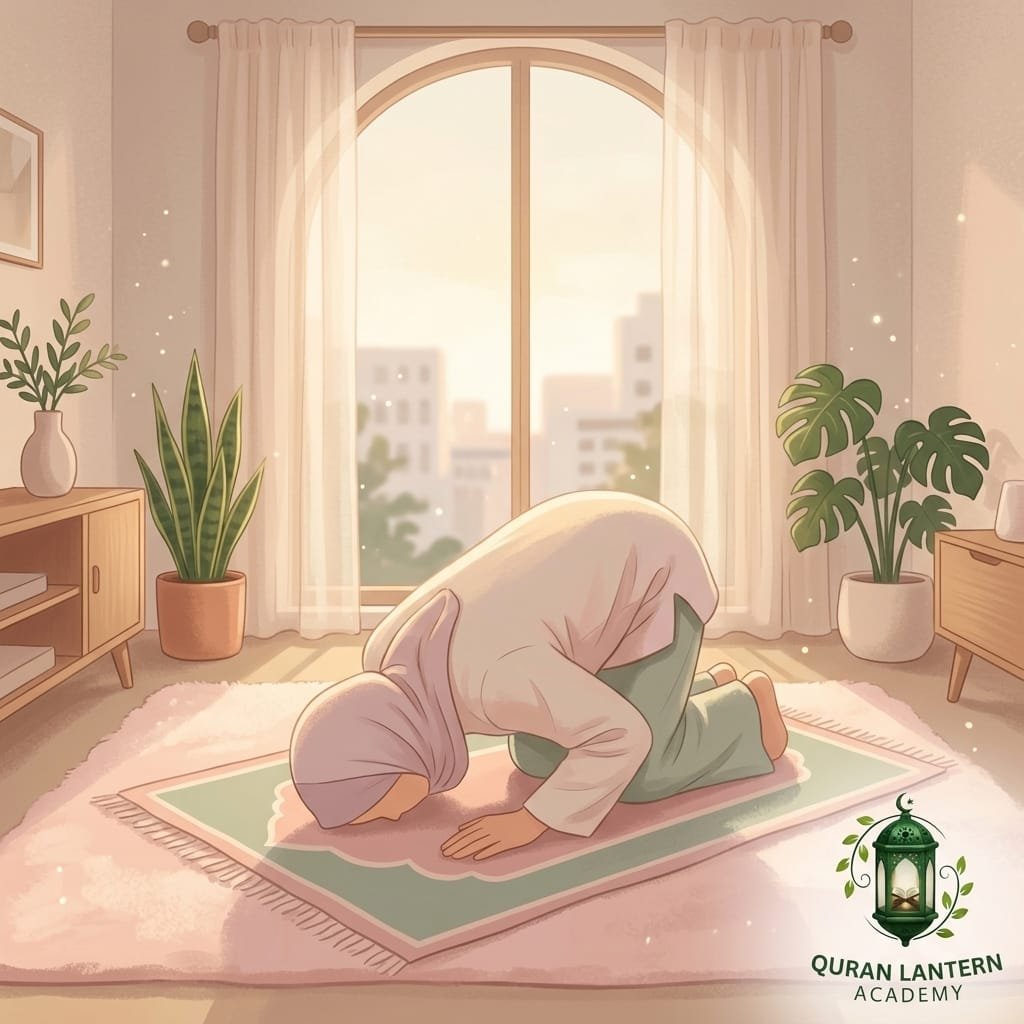
Gently lower yourself to the floor, placing your forehead, nose, palms of your hands, knees, and toes firmly on the ground. This is the most humbling and beloved posture in prayer, as you are physically at your lowest point, yet spiritually closest to Allah. Whisper three times: “Subhana Rabbiyal A’la” (Glory be to my Lord, the Most High).
Step 6: Sitting and the Second Prostration
Sit back up briefly on your heels, resting your hands on your thighs, then perform a second prostration (Sujud) exactly like the first one. This completes one full Rakat!
How to Apply This in Your Daily Life
Learning how to pray in islam is a journey, not a sprint. Here are some compassionate, practical tips to help you apply this daily without feeling overwhelmed:
- Take It One Step at a Time: If learning all five prayers at once feels heavy, start with just one or two prayers a day. Build the habit gradually.
- Use a Cheat Sheet: Print out a phonetic guide or translation card and place it on a stand in front of you while you pray. There is no shame in reading from a guide when you are a beginner.
- Be Gentle With Yourself: You will forget steps, lose count of your Rakats, or stumble over words. That is completely normal! Allah loves the effort of the one who struggles to learn.
- Establish a Routine: Tie your prayer times to daily anchors, like waking up, lunch breaks, or coming home from work.
Conclusion
Embarking on the path of learning how to pray in islam is one of the most rewarding decisions you will ever make. Remember that you are never alone in this journey. At Quran Lantern Academy, we are dedicated to supporting new Muslims with compassionate guidance, authentic knowledge, and a welcoming community. Take your first breath of peace today, unfold your prayer mat, and take that beautiful step toward your Creator.