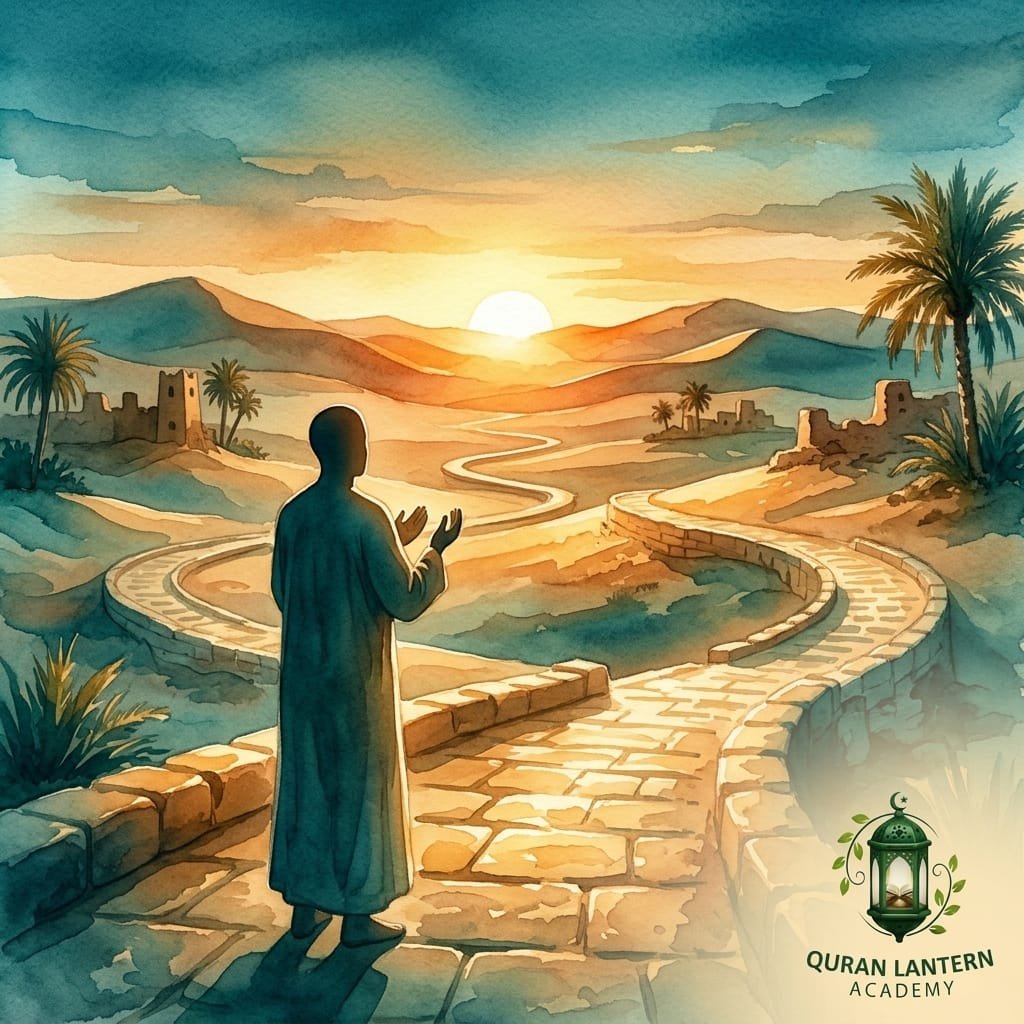
Welcome, Dear Friend, to a Journey of Resilience
Assalamu Alaikum (Peace be upon you), dear brother or sister! If you are new to Islam, first of all, welcome home. Taking that brave step to embrace the truth is a monumental milestone, and we at Quran Lantern Academy are honored to walk beside you on this beautiful path.
However, we know that the journey of faith is not always an easy stroll in a garden. Sometimes, embracing Islam brings unexpected tests—whether it is facing the gentle or harsh misunderstandings of family members, navigating dietary changes, or simply trying to balance a new lifestyle in a world that often operates differently. When these moments feel heavy, where do we turn? Who can we look to for inspiration?
Today, we invite you to look back in time, over 1,400 years ago, to the life of one of the most beloved companions of Prophet Muhammad (peace be upon him). His name was Bilal ibn Rabah, and his story is one of the most powerful chapters in the Stories from the Seerah (the biography of the Prophet).
Who Was Bilal ibn Rabah?
To truly appreciate Bilal’s story, we have to understand his humble and difficult beginnings. In early Makkah, before Islam brought equality and dignity to all, Bilal was an enslaved man of Abyssinian descent. In the eyes of the cruel elite of Makkah, he had no social status, no wealth, and no rights.
Yet, when the message of Islam reached his ears—a message proclaiming that all human beings are equal before the One True God, and that the only thing that separates people is their character and God-consciousness—Bilal’s heart instantly recognized the truth. He whispered the Shahada (the declaration of faith): “There is no god worthy of worship except Allah, and Muhammad is His messenger.”
The Test of Unshakeable Faith
For Bilal, accepting Islam came with an immediate and agonizing cost. His master, Umayyah ibn Khalaf, was furious that a man he considered property had chosen a faith that placed spiritual freedom above human tyranny.
Umbayyah subjected Bilal to tortures designed to break his spirit and force him to renounce Islam. Under the scorching, blistering heat of the Arabian desert sun, Bilal was forced to lie flat on the burning sand. A massive, heavy boulder was crushed onto his chest to suffocate him. The tormentors demanded only one thing: “Renounce Muhammad, and worship our idols.”
The Power of “Ahad, Ahad”
Imagine the scene, dear friend. The heat, the physical pain, the loneliness. Yet, what did Bilal say? Did he curse his tormentors? Did he give up?
With every ounce of breath left in his battered body, Bilal uttered just one word, over and over again, like a spiritual anchor in a violent storm:
“Ahad… Ahad…” (The One… The One…)
He was reminding himself—and everyone listening—that God is One, He is Supreme, and no human being has power over a soul that belongs entirely to the Creator. Bilal’s physical body was chained and tortured, but his soul was completely free.
Eventually, Bilal was purchased and set free by Abu Bakr (may Allah be pleased with him), one of the closest companions of the Prophet. But Bilal’s story didn’t end with his freedom; it soared.
From the Desert Sand to the Highest Honor
Because of his unwavering patience, loyalty, and the pure beauty of his voice, the Prophet Muhammad (peace be upon him) chose Bilal for a magnificent honor. When Islam established its roots in Madinah, it was time to call the believers to prayer. The Prophet chose Bilal to be the very first Mu’adhin (the one who calls the Adhan) in Islamic history.
Imagine that transformation! The man who once lay crushed under a boulder on the burning sand was now standing high above the city, projecting a voice that echoed across Madinah five times a day, declaring the greatness of God.
Lessons from Bilal’s Life for New Muslims
You might be wondering, “This is a touching story, but how does it relate to my life today in the 21st century? I am not being dragged across desert sand.”
While physical torture for faith is rare today, the spiritual and emotional “boulders” we carry can feel just as heavy. As a new Muslim, your tests might look like:
- The loneliness of standing alone in your new beliefs while family or friends do not understand.
- The internal struggle to break old habits and build new, healthy, Islamic routines.
- The feeling of being overwhelmed by learning how to pray, read the Quran, and practice the faith correctly.
Bilal’s story teaches us that true peace comes from holding on to your connection with God, no matter how heavy the pressure is around you.
How to Apply This in Your Daily Life
Here are three practical ways you can bring the spirit of Bilal into your daily routine as a new Muslim:
1. Find Your Personal “Ahad” When Overwhelmed
When life feels difficult, or when doubts and anxieties whisper in your mind, take a deep breath and return to the basics. Remember the oneness of God. Whisper La ilaha illa Allah (There is no god except Allah). Let His remembrance be the boulder-crushing strength in your heart.
2. Embrace Patience (Sabr) in Your Learning Curve
Do not rush yourself. Learning Islam is a marathon, not a sprint. If you stumble, pick yourself back up. Bilal did not become a hero overnight; his resilience was built moment by moment, breath by breath. Celebrate your small victories every single day.
3. Connect Deeply with the Call to Prayer (Adhan)
Next time you hear the Adhan—or listen to it on your phone—close your eyes and remember Bilal. Remember that the words echoing from the minarets are the very same words that men and women like Bilal preserved through unimaginable sacrifice. Let that call pull you toward peace.
Conclusion
Dear friend, your journey in Islam is precious. Every challenge you face is a stepping stone to building spiritual strength, just like it was for the early companions. You are never alone on this path. At Quran Lantern Academy, we are dedicated to lighting your way with knowledge, compassion, and community. May Allah make your trials easy, fill your heart with steadfastness, and surround you with His infinite mercy. Until next time, stay strong, keep learning, and keep shining!