Welcome to the Heart of Islamic Worship
Assalamu Alaikum (Peace be upon you), dear brother or sister! First and foremost, welcome home. Embracing Islam is a momentous, beautiful journey, and taking your first steps into daily Islamic worship—known as Salah (prayer)—is one of the most exciting milestones of your new life.
If you are feeling a bit overwhelmed by the physical movements, the Arabic words, and the timing, please take a deep breath. Allah (God) sees your effort, your sincerity, and every single stumble you make on this path. In fact, Prophet Muhammad (peace be upon him) taught us that the one who struggles to recite the Quran or perform prayer while it is difficult for them will actually receive double the reward! So, be gentle with yourself. You do not need to be an expert overnight.
What is Salah and Why Do We Do It?
At its core, Salah is not just a chore or a rigid list of physical exercises. It is a direct, personal appointment with your Creator five times a day. Imagine having a direct phone line to the One who loves you more than anyone else in the world, the One who created the stars, the oceans, and your own heartbeat. That is what prayer is. It is a moment to pause the chaos of the world, catch your breath, and find profound peace.
The Prerequisites: Getting Ready for Prayer
Before you stand before Allah in prayer, there are a few simple preparations required to ready your body and mind:
- Wudu (Ritual Ablution): This is the ritual washing of specific parts of the body (hands, mouth, nose, face, arms, head, and feet) with water. It refreshes you physically and mentally, signaling a transition from worldly distractions to sacred focus.
- Cleanliness: Your body, clothes, and the place where you pray must be clean.
- Modest Clothing: Men should cover from the navel to the knee at minimum. Women should cover their entire body except for the face and hands.
- Facing the Qibla: You must face the direction of the Kaaba in Mecca. Don’t worry—there are plenty of smartphone apps to help you find this instantly!
The 5 Daily Prayers
Muslims pray five times a day, spread out from dawn until night. Each prayer takes only about 5 to 10 minutes:
- Fajr: The dawn prayer, prayed before sunrise.
- Dhuhr: The midday prayer, prayed after the sun passes its peak.
- Asr: The late afternoon prayer.
- Maghrib: The sunset prayer, prayed just after the sun goes down.
- Isha: The night prayer, prayed after twilight has faded.
Step-by-Step Guide to Performing a Prayer Unit (Rak’ah)
A prayer is made up of units called Rak’ahs (singular: Rak’ah). Let’s break down a single unit step-by-step. Do not worry about memorizing all the Arabic right away; you can use a cheat sheet or your phone to read from it while you learn!
1. The Intention (Niyyah) and Opening Takbir
Stand facing the Qibla. You don’t need to say your intention out loud; just know in your heart which prayer you are about to perform. Raise your hands to your ears or shoulders and say: “Allahu Akbar” (God is the Greatest). This locks you into the sacred space of prayer.
2. Standing and Reciting Al-Fatihah
Place your right hand over your left hand on your chest or slightly below. Recite the opening chapter of the Quran, known as Surah Al-Fatihah. This is the most important chapter in the Quran and is recited in every single unit of prayer. If you haven’t memorized it yet, you can read it from a paper or screen, or simply say “SubhanAllah” (Glory be to Allah) while you are learning.
3. Bowing (Rukoo’)
Say Allahu Akbar and bow at the waist, keeping your back straight and placing your hands on your knees. While in this position, gently say: “Subhana Rabbiyal Adheem” (Glory be to my Lord, the Magnificent) three times.
4. Rising from the Bow
Stand back up straight, raising your hands slightly, and say: “Sami’Allahu liman hamidah” (Allah hears whoever praises Him). Once fully standing, say: “Rabbana wa lakal hamd” (Our Lord, and to You belongs all praise).
5. Prostration (Sujud)
Say Allahu Akbar and lower yourself gently to the ground. This is the closest you will ever be to Allah! Seven parts of your body must touch the ground: your forehead and nose, both hands, both knees, and the toes of both feet. While in prostration, say: “Subhana Rabbiyal A’la” (Glory be to my Lord, the Most High) three times.
6. Sitting Briefly and Second Prostration
Sit up on your heels for a brief moment, saying Allahu Akbar, and then repeat the prostration (Sujud) a second time, repeating “Subhana Rabbiyal A’la” three times.
Congratulations! You have just completed one Rak’ah (unit). For a two-unit prayer (like Fajr), you will stand up and repeat these steps once more, ending with a special sitting posture called Tashahhud to send peace upon the Prophet and declare your faith.
How to Apply This in Your Daily Life
Learning how to pray can feel like learning a new language and a new dance all at once. Here is how you can make this practical and stress-free:
- Take it one step at a time: Don’t try to learn all five prayers perfectly on day one. Start with just one or two prayers a day until you feel comfortable.
- Use translation aids: Keep a transliteration guide or a phone app nearby during your prayer. Allah knows your tongue is adjusting, and He appreciates your sincere effort to speak to Him in Arabic.
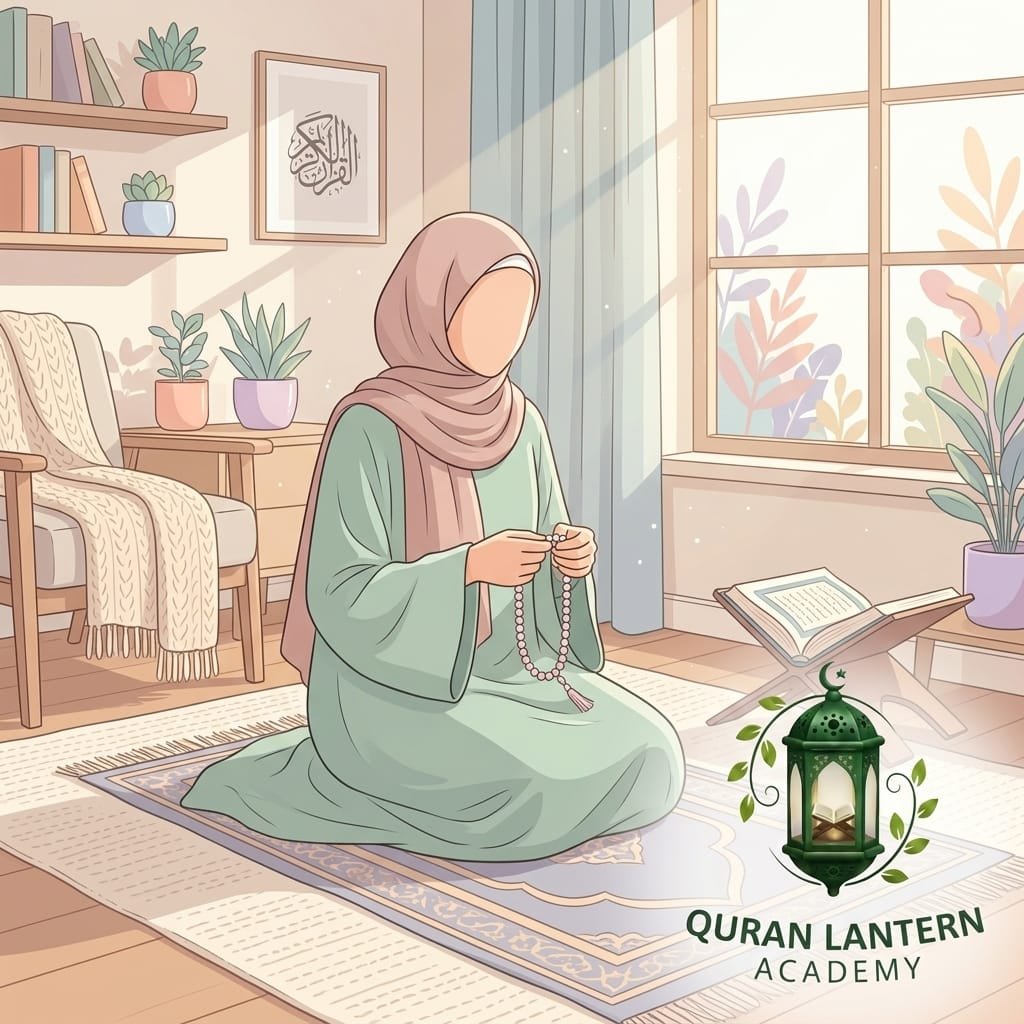
- Create a sacred corner: Set up a clean, quiet corner in your home with a comfortable prayer mat and good lighting. Having a dedicated physical space helps cue your brain for worship.
- Be patient with yourself: Consistency beats perfection every single time. Two minutes of heartfelt, clumsy prayer is infinitely better than skipping it because you think you aren’t doing it “right enough.”
Conclusion
Remember, dear friend, your journey to mastering the Islamic prayer is a marathon, not a sprint. Every time you stand on your prayer mat, you are building a magnificent relationship with the Creator of the universe. At Quran Lantern Academy, we are honored to walk beside you on this incredible journey. If you ever feel stuck or have questions, our community is here to support you with open arms and gentle guidance. May Allah make your prayers a source of ultimate comfort, peace, and joy for your heart!