Welcome to Your Journey of Salah
Assalamu Alaikum (Peace be upon you), dear friend! Welcome to the beautiful journey of Islam. If you are a new Muslim (revert), taking those first steps to learn how to pray—known in Arabic as Salah—might feel a little overwhelming at first. You might worry about memorizing the Arabic words, getting the physical movements right, or feeling like you are doing everything “correctly.”
Please take a deep breath and let your heart rest. Allah (God) sees your sincere effort. He knows every heartbeat, every stumbled word, and every tear of devotion. The Prophet Muhammad (peace be upon him) taught us that Allah is extremely loving and patient with us. Learning Salah is not about perfection overnight; it is about building a daily conversation and connection with your Creator.
What is Salah and Why Do We Do It?
In simple terms, Salah is the Islamic ritual prayer performed five times a day. But it is so much more than just a daily chore or a set of physical movements. It is your personal appointment with the Creator of the universe. In a world full of noise, anxiety, and endless distractions, Salah is your spiritual oasis—a sacred pause where you can drop your heavy burdens and rest in the peace of remembering Allah.
The Quran reminds us: “Verily, in the remembrance of Allah do hearts find rest.” (Quran 13:28). When you stand on your prayer rug, you are stepping away from the chaos of the dunya (worldly life) and speaking directly to the One who loves you more than anyone else.
The Prerequisites: Preparing for Prayer
Before you begin your prayer, there are a few simple physical and spiritual preparations required to make sure your body and heart are ready:
- Wudu (Ablution): A ritual washing of specific parts of the body (hands, mouth, face, arms, head, and feet) with clean water to achieve ritual purity.
- Clean Clothing and Space: Ensure your clothes and the area where you pray are clean and free of impurities.
- Modest Attire: Cover your body appropriately. For men, this means from the navel to the knee. For women, it means covering the entire body except for the face and hands.
- Facing the Qiblah: Facing in the direction of the Kaaba in Makkah. Don’t worry about getting the exact angle right away; apps on your phone can easily help you find the direction.
- Timing: Knowing the designated time window for each of the five daily prayers (Fajr, Dhuhr, Asr, Maghrib, and Isha).
Step-by-Step Breakdown of the Islamic Prayer
Each prayer is made up of units called Rakats. Depending on the time of day, a prayer can have 2, 3, or 4 Rakats. Here is what a single Rakat looks like, broken down step-by-step:
1. The Intention (Niyyah) and Opening Takbir
You stand facing the Qiblah. You don’t need to speak your intention out loud; just make a clear intention in your heart for which prayer you are about to perform. Then, raise your hands to your shoulders or ears and say: “Allahu Akbar” (God is the Greatest). This marks the official beginning of your prayer, and from this moment, you keep your focus entirely on Allah.
2. Standing and Reciting the Quran
Place your right hand over your left hand on your chest or upper stomach. You will recite the opening chapter of the Quran, called Al-Fatihah (The Opening). If you are still learning Arabic, don’t worry! You can read from a translation or a transliteration sheet, or simply praise Allah in your native language until you learn the Arabic verses. After Al-Fatihah, you recite a short chapter from the Quran.
3. Bowing (Ruku)
Say “Allahu Akbar” and bow forward from your hips, keeping your back straight and placing your hands on your knees. While in this position of humility, you quietly say: “Subhana Rabbiyal Azeem” (Glory be to my Lord, the Magnificent) three times.
4. Rising from the Bow
Stand back up straight, raising your hands slightly, and say: “Sami’Allahu liman hamidah” (Allah hears the one who praises Him), followed by “Rabbana wa lakal hamd” (Our Lord, to You belongs all praise).
5. Prostration (Sujood)
This is the most beautiful and beloved part of the prayer! Say “Allahu Akbar” and gently lower yourself to the floor. Seven parts of your body must touch the ground: your forehead and nose, both palms, both knees, and the toes of both feet. In this position, you are physically lower than you have ever been, which means you are spiritually closest to Allah. Whispering your personal duas (supplications) here is deeply encouraged. Say: “Subhana Rabbiyal A’la” (Glory be to my Lord, the Most High) three times.
6. Sitting Between Prostrations
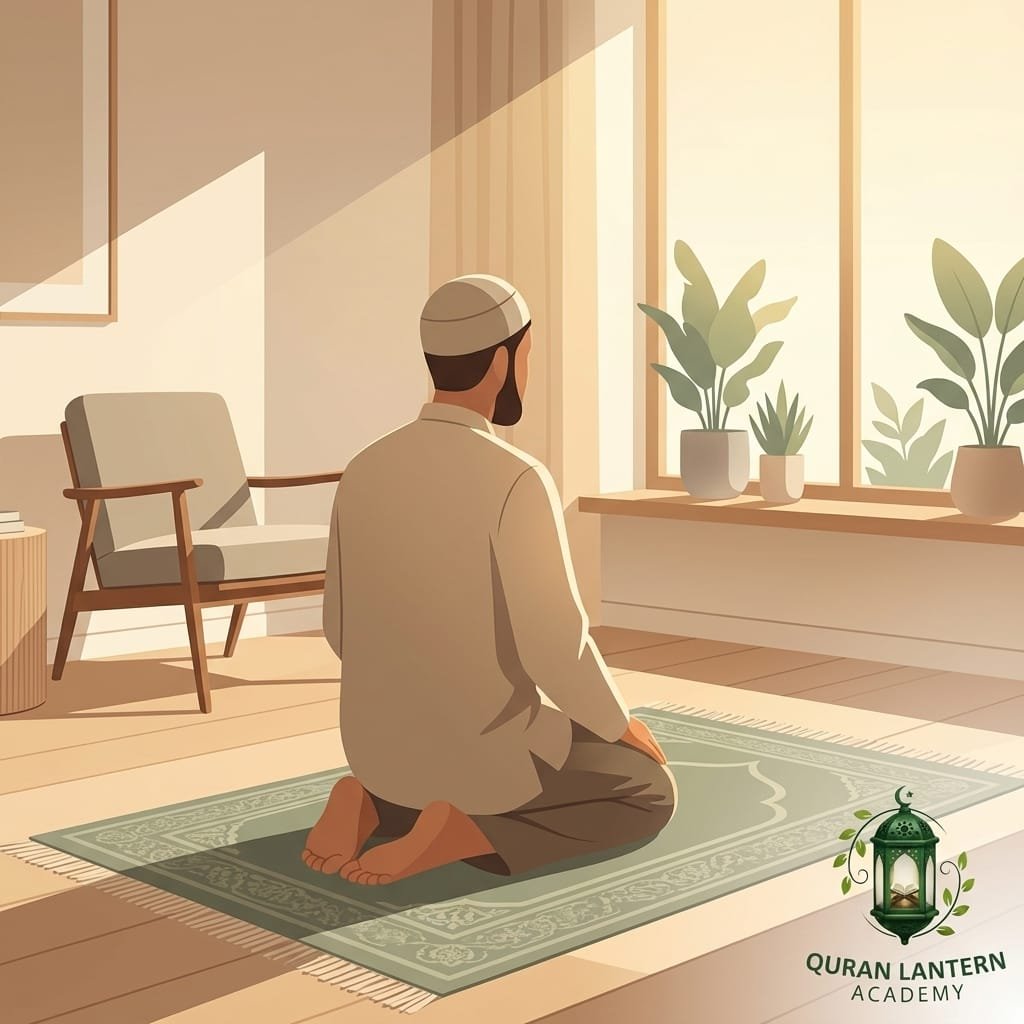
Sit up briefly, resting your weight on your left foot with your right foot resting on its toes, and say “Allahu Akbar.” You can pause here to ask Allah for forgiveness and mercy, then perform a second prostration (Sujood) just like the first one.
7. The Concluding Sitting (Tashahhud)
After completing your final Rakat (whether it is the second, third, or fourth), you sit on the floor and recite words of testimony, peace, and blessings upon the Prophets. You conclude your prayer by turning your head to the right and saying “Assalamu alaykum wa rahmatullah” (Peace and mercy of Allah be upon you), and then repeating it to the left.
How to Apply This in Your Daily Life
Transitioning into praying five times a day can feel daunting if you try to do it all at once. Here are some practical tips to help you apply this step-by-step:
- Take it One Step at a Time: If learning all five prayers feels heavy, start with just one or two a day, and gradually build up to all five. Allah loves consistent, small deeds over massive deeds that lead to burnout.
- Use Cheat Sheets: Do not hesitate to use flashcards, phone apps, or cheat sheets placed on a music stand or chair in front of you while you pray. It is completely permissible for a beginner!
- Be Patient with Memory: Your brain is adapting to new languages and rhythms. Celebrate every small milestone, such as memorizing a new line of Al-Fatihah.
- Create a Sacred Space: Designate a clean, quiet corner in your home with a comfortable prayer rug where you look forward to spending your quiet moments.
Conclusion: You Are Never Alone
Remember, dear brother or sister, Allah does not look at the clumsiness of your movements or the imperfections of your pronunciation; He looks at the sincerity beating inside your chest. Every single stumble is seen as an act of striving, and striving in the path of Allah is deeply rewarded. At Quran Lantern Academy, we are honored to walk beside you on this magnificent journey of faith. Take a deep breath, trust the process, and enjoy the profound peace of bowing your heart to the One who created you.