Welcome to the Heart of Islamic Worship: Salah
Assalamu alaikum (Peace be upon you), dear friend! If you are a new Muslim (revert), first of all, welcome home. Taking the step to embrace Islam is a beautiful journey, and we are so honored to walk beside you. One of the very first things you will learn as you grow in your faith is Salah, the daily Islamic prayer. When you first look at Salah, it might feel a little overwhelming. There are movements to learn, phrases to memorize, and specific times to observe. But take a deep breath! Allah looks at your sincere effort, not your perfection. Every stumble is an act of worship in itself because you are trying.
At Quran Lantern Academy, we believe that prayer should never feel like a burden. Instead, think of Salah as your daily appointment to unplug from the chaos of the world and connect directly with the One who loves you most. Let us walk through the prayer step-by-step together, gently and at your own pace.
What is Salah and Why Do We Do It?
In simple terms, Salah is a direct line of communication between you and Allah (God). While making personal dua (supplication) is wonderful, Salah is a structured conversation commanded by Allah. Muslims perform Salah five times a day. These moments act as spiritual anchors, keeping us grounded, mindful, and at peace throughout a busy day.
- Fajr: Performed before sunrise (the dawn prayer).
- Dhuhr: Performed after the sun passes its peak (the midday prayer).
- Asr: Performed in the late afternoon.
- Maghrib: Performed right after sunset.
- Isha: Performed at night, after twilight has faded.
Preparing for Prayer: The Basics
Before you begin your prayer, there are a few physical and spiritual preparations required to make sure your body and heart are ready.
1. Purity (Wudu)
Before praying, we perform Wudu (ablution), which is a ritual washing of the hands, mouth, nose, face, arms, head, and feet with water. Wudu cleanses you physically and symbolically refreshes your mind before you stand before your Creator.
2. Modest Clothing and a Clean Space
You will need to wear clean clothing that covers your ‘awrah (the parts of the body that must be covered in front of others—for men, generally from navel to knee; for women, the entire body except the face and hands). Find a quiet, clean spot in your home, lay down a prayer rug (though any clean surface is fine), and face the direction of the Kaaba in Makkah, known as the Qiblah.
Step-by-Step Guide to Performing Salah
Let us break down a standard unit (called a Rak’ah) of prayer into simple, easy-to-follow steps.
Step 1: The Intention (Niyyah) and Opening Takbir
Stand facing the Qiblah. You do not need to say your intention out loud; just know in your heart which prayer you are about to perform. Raise your hands to your ears (or shoulders) and say: “Allahu Akbar” (God is the Greatest). This phrase is called the Takbir and marks the beginning of your sacred conversation.
Step 2: Standing and Reciting the Quran
Place your right hand over your left hand on your chest or upper stomach. You will gently recite Surah Al-Fatihah (the opening chapter of the Quran). If you are still learning, don’t worry! You can recite it in English translation for now, or simply praise Allah while you practice learning the Arabic over time.
Step 3: Bowing (Ruku)
Say Allahu Akbar again and bow from your waist, placing your hands on your knees, keeping your back straight. While bowing, quietly say: “Subhana Rabbiyal Azeem” (Glory be to my Lord, the Magnificent) three times.
Step 4: Standing Up Straight (I’tidal)
Rise back up to a standing position, saying: “Sami’Allahu liman hamidah” (Allah hears whoever praises Him), followed by “Rabbana wa lakal hamd” (Our Lord, and to You belongs all praise).
Step 5: Prostration (Sujud)
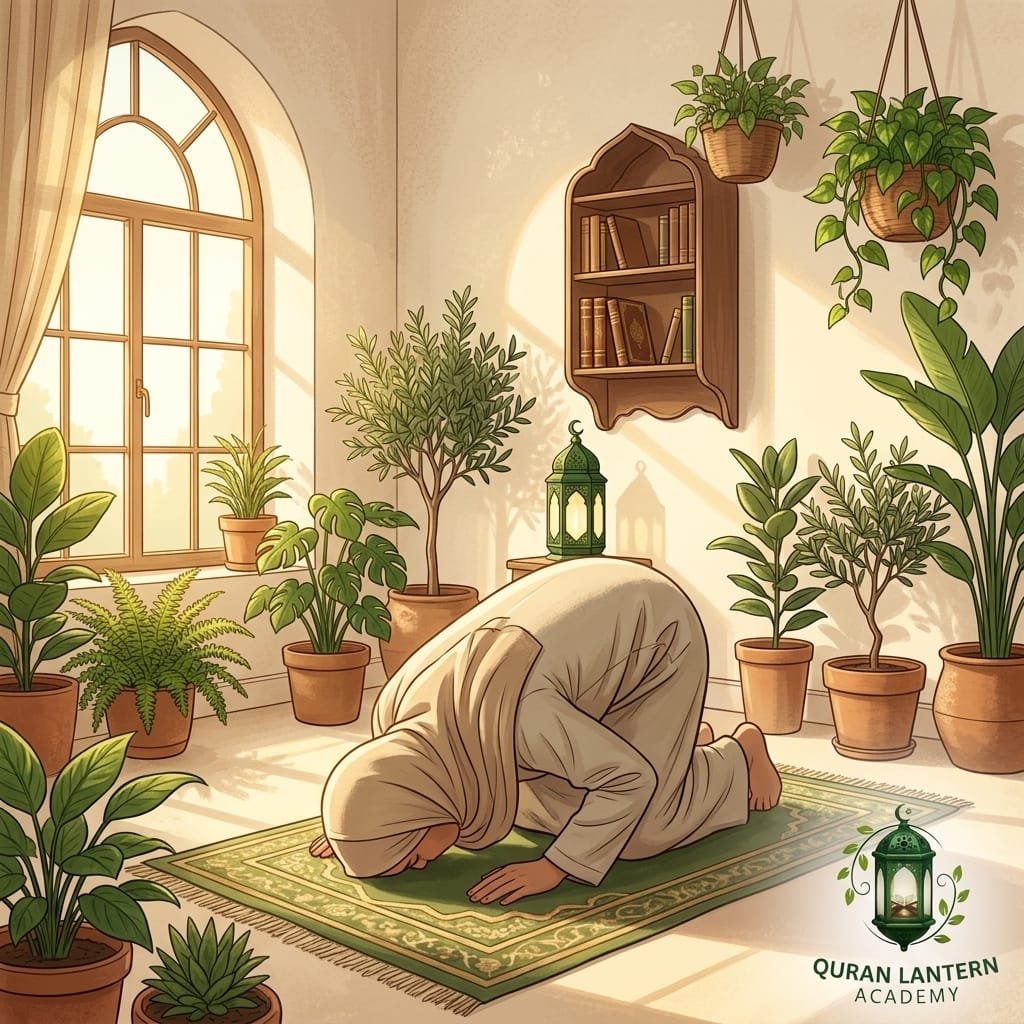
This is the most beloved posture in prayer because you are physically closest to Allah. Say Allahu Akbar and gently lower yourself to the floor, touching your forehead, nose, palms, knees, and toes to the ground. While in prostration, say: “Subhana Rabbiyal A’la” (Glory be to my Lord, the Most High) three times. Pour your heart out here; you can ask Allah for anything you need in your native language!
Step 6: Sitting and the Final Salam
After two prostrations, you briefly sit up on your heels, then perform a second prostration. Depending on which prayer you are doing, you will eventually sit to recite the final testimony of faith (Tahiyyah). Finally, end your prayer by turning your head to the right and saying “Assalamu alaikum wa rahmatullah” (Peace be upon you and the mercy of Allah), and then repeat it looking to the left.
How to Apply This in Your Daily Life
Learning Salah can feel like learning a new choreography combined with a new language. To avoid burnout, try these practical tips:
- Take it one step at a time: If you don’t know all the Arabic words yet, pray along with an audio guide, or say simple phrases like “Subhanallah” (Glory be to God) or “Alhamdulillah” (Praise be to God) while you learn.
- Use a cheat sheet: There is no shame in holding a piece of paper or having a tablet in front of you with the words written down. Allah knows your heart.
- Establish a routine: Tie your prayer times to daily habits, like waking up, lunch breaks, or coming home from work.
- Be patient with yourself: Perfection is not expected from day one. Allah rewards your sincere struggle far more than flawless execution.
Conclusion
Remember, dear brother or sister, that Salah is a gift, not a chore. It is your sanctuary in the middle of a noisy world—a time where your soul gets to breathe. Be gentle with yourself as you learn this beautiful practice. If you ever feel stuck, reach out to mentors and teachers who can support you. Here at Quran Lantern Academy, we are dedicated to making your journey into learning the Quran and Islamic practices as warm, encouraging, and accessible as possible. May Allah make your prayers a source of deep joy, peace, and ultimate success in this life and the next. Ameen!